How to edit your SPF record at GoDaddy
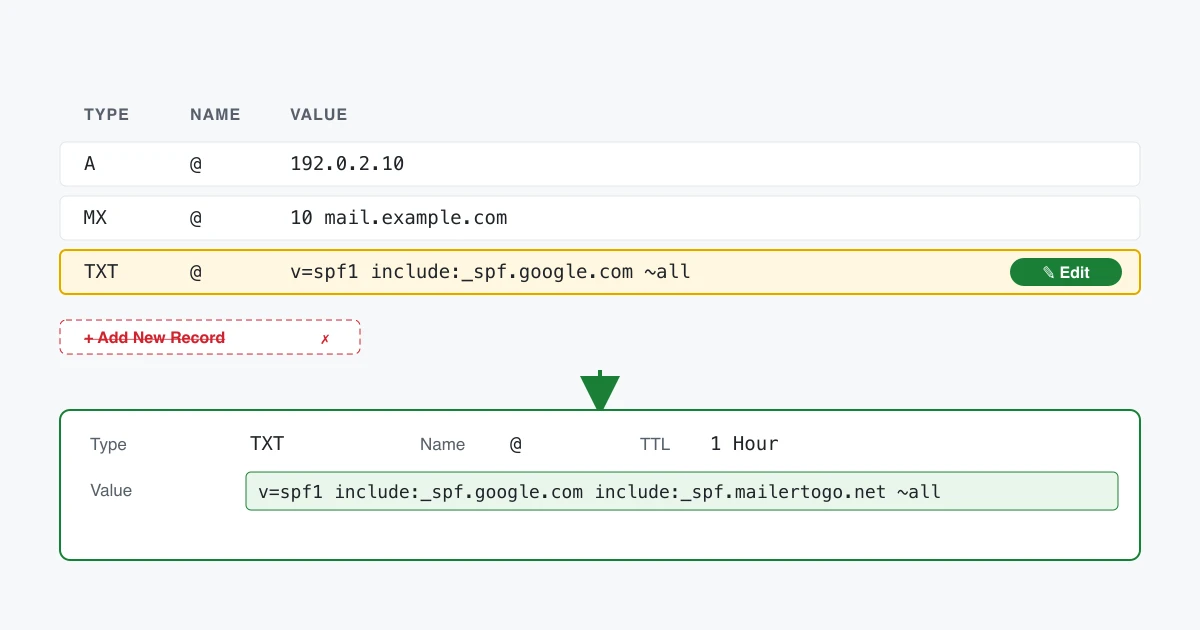
You are editing one record, not adding another. A domain may publish only one SPF record — RFC 7208 §4.5 — and a second one makes mail from your domain fail authentication at Gmail, Outlook and everywhere else. If you already have a line starting v=spf1, that is the line to change.
Find the record
- Sign in at godaddy.com and open My Products.
- Find your domain and select DNS (some accounts label this “Manage DNS”).
- In the Records table, look for a row with Type: TXT whose value starts with
v=spf1. If one exists, select the pencil / Edit icon on that row — do not add a new row. If none exists, select Add New Record and choose TXT.
Set the fields
- Type:
TXT - Name:
@— GoDaddy uses@to mean the domain itself. Do not type your domain name here; that creates a record atexample.com.example.com, which is the most common mistake on this screen. - Value: your finished SPF record
- TTL: leave the default (1 hour)
Select Save.
Combining senders
If your existing record is:
v=spf1 include:_spf.google.com ~allthe finished record is:
v=spf1 include:_spf.google.com include:_spf.mailertogo.net ~allOne v=spf1 at the start, every include: in the middle, and the ~all (or -all) last — anything after it is ignored. Keep every sender you already had; removing one stops that service's mail from authenticating.
If you send from a subdomain
If your sending domain is mail.example.com, it usually has no DNS records of its own — it inherits them from the parent domain. Make the change on the parent domain's DNS, and look for the record whose name is the subdomain.
Check it worked
GoDaddy usually publishes within an hour. Then paste your domain into our SPF checker — it reads what is actually published, breaks the record down term by term, and tells you whether it authorises us.
Why only one record
An SPF record tells receiving mail servers which servers may send as your domain. The receiver checks it during the SMTP conversation, at MAIL FROM, before it accepts the message. RFC 7208 §4.5 says a domain must publish only one, and §4.6 makes a second one a permanent error — the receiver is entitled to discard the whole evaluation. Two records is worse than one wrong one.